AI predictions
AI Predictions, See Problems Before They Happen
NetEngineX’s AI engine learns your network’s normal and warns you the moment something is drifting toward a problem. Detect risk patterns before users start reporting them.
From Reactive Monitoring to Predictive Intelligence
Traditional monitoring is good at telling you when a threshold has already been crossed. By that point, users may already be affected, support tickets may already be opening, and your team is forced into response mode.
Networks and services usually do not fail all at once. They drift first. Latency moves away from its normal baseline. Packet loss begins to appear in bursts. Jitter becomes unstable. Service response times trend upward before performance becomes clearly degraded. These early signals are easy to miss when teams are scanning raw charts across many destinations and services.
NetEngineX AI Predictions is built to surface those early patterns from your stored monitoring history. Across ping, service, and MTR workflows, it helps operators see baseline drift, anomaly pressure, forecast risk, outliers, and possible path-change behavior so they can investigate degradation earlier and act before it becomes a larger outage.
“Every outage leaves footprints in the data hours, sometimes days, before it happens. NetEngineX AI follows the footprints.”
Built on the Data You Already Trust
The strength of any AI system is the data behind it. NetEngineX’s AI doesn’t rely on guesswork or external feeds. It learns directly from your network’s own telemetry, drawn from three rich data streams:
📡
Ping Telemetry, Latency, Jitter & Loss Patterns
The AI engine builds an adaptive baseline for each monitored target from its stored history, including normal latency, jitter, and packet-loss behavior, then compares new results against that baseline to surface drift early. This helps operators quickly spot latency degradation, jitter instability, packet-loss bursts, and unusual trend movement, and identify whether a destination is stable, worth watching, or trending toward degradation.
🌐
Service Health, Response Time & Availability Trends
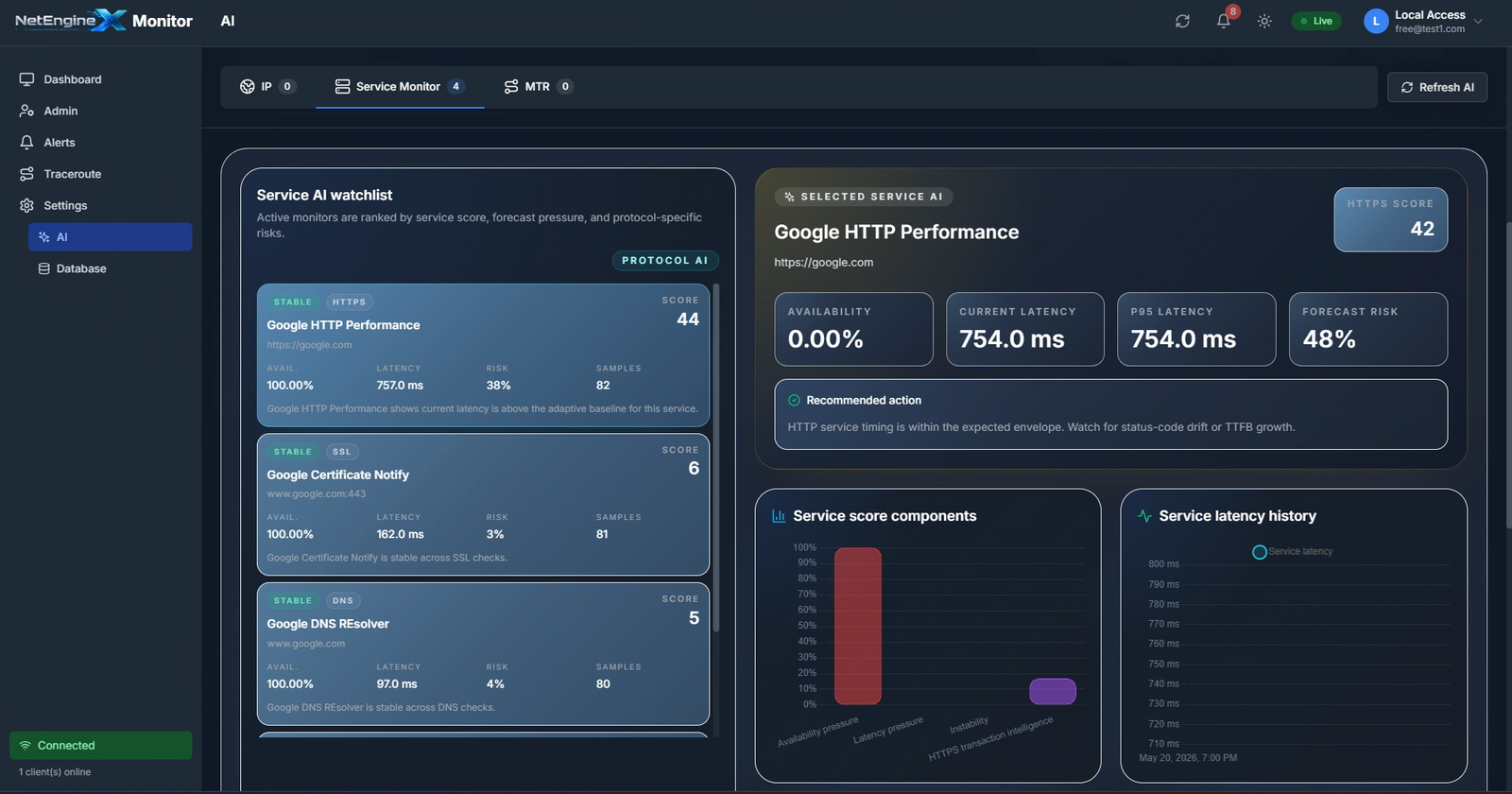
Every HTTP, HTTPS, DNS, SSL, TCP, and UDP monitor contributes protocol-aware signals into the AI engine. NetEngineX compares 5-minute service latency history against an adaptive baseline, then combines latency drift, availability pressure, warning and critical states, and short-horizon forecast risk with protocol-specific evidence such as DNS timeout and no-answer patterns, HTTP status and phase timing drift, TCP connect failures, UDP no-response behavior, and SSL/TLS certificate or handshake issues. This helps operators catch creeping response-time degradation and unstable service behavior early, with clear narrative and recommended action before the issue grows into a larger outage.
🛰
MTR Path Data, Routing & Hop Behavior
By analyzing scheduled MTR runs over time, the AI compares route snapshots, hop loss, latency, jitter, no-reply behavior, and path changes to highlight route instability and suspicious hops. It ranks recurring worst hops, tracks path variants across the selected history window, and helps operators see whether degradation is likely path-related, including provider or ASN boundary clues when available, so unstable routes can be investigated earlier and with better context.
What the AI Actually Detects
NetEngineX’s AI is purpose-built for the patterns that matter in network and service monitoring. Here’s what it watches for:
PATTERN
Gradual Degradation
The slow-burn failure. Latency rises a few milliseconds at a time, packet loss begins to appear in bursts, and jitter becomes less stable. By the time a fixed threshold fires, the destination may already be drifting away from its normal baseline. NetEngineX surfaces that degradation early so teams can investigate before it becomes more visible.
PATTERN
Anomalous Behavior
Sometimes the problem isn’t a threshold. It’s that the data simply doesn’t look like it usually does. A service that normally responds in 80ms is suddenly bouncing between 40ms and 200ms. The AI compares current behavior against the learned baseline and flags anything that breaks the pattern.
PATTERN
Recurring Issues
Some issues are not random. They repeat at certain times of day or return in similar operating conditions. NetEngineX uses stored monitoring history to surface recurring patterns, baseline drift, and repeated outlier behavior so teams can investigate problems that might otherwise look like isolated events.
PATTERN
Short-Horizon Forecasts
NetEngineX uses recent stored history to build short-horizon forecasts for latency and service behavior. This helps operators see when degradation pressure is building, whether the latest trend is moving away from baseline, and whether a destination is stable, worth watching, or trending toward degradation.
PATTERN
Cross-Signal Context
Ping, service, and MTR signals are strongest when viewed together. A latency rise in ping, a response-time increase in service monitoring, and a suspicious hop in MTR can give operators better context about whether the issue is path-related or endpoint-related. NetEngineX helps teams compare these signals side by side for faster investigation.
Predictions That Pay Off
The AI flags a steady rise in latency and instability on a critical destination. Your team investigates while the service is still usable, validates the cause, and resolves it during planned work instead of during an emergency.
A service’s response time keeps drifting above its normal range. Forecast risk rises, the AI narrative shifts from stable to watchlist behavior, and your team gets time to investigate before users start feeling the impact.
Packet loss, jitter, or response-time spikes begin showing up in a repeatable way across stored history. NetEngineX surfaces the repeated behavior so your team can investigate operational or path-related causes with better evidence.
A service degrades, and the AI view shows latency drift alongside MTR path instability and suspicious-hop pressure. Instead of starting from scratch, your team can quickly tell whether the issue looks more path-related or endpoint-related.
Why Earlier Insight Beats Purely Reactive Monitoring
Reactive monitoring tells you when a threshold has already been crossed. NetEngineX AI helps teams see degradation pressure, baseline drift, unstable behavior, and path-related warning signs earlier so they can investigate with more context and respond before problems grow:
- ★Earlier intervention: Surface warning signs while the destination or service is still drifting, not only after it fails.
- ★Faster investigation: Ping, service, and MTR views help teams separate endpoint issues from path instability more quickly.
- ★Better operational decisions: Short-horizon forecasts and baseline trends make it easier to decide what needs attention now.
- ★Less noise, more context: AI scoring, outliers, narratives, and recommended actions help operators focus on the signals that matter.
- ★Better user experience: Teams can respond earlier to degradation before it becomes more visible to customers.
- ★Stronger SLA operations: Earlier detection helps reduce surprises, improve response quality, and support more reliable service delivery.
“The best incident is the one your team had time to investigate before users ever felt it.”
Who Should Be Using This?
NetEngineX AI Predictions is built for teams that want earlier warning, clearer context, and faster investigation across network, service, and path behavior:
- →NOC & SOC Teams: Reduce alert noise and focus faster on unstable destinations, degrading services, and rising anomaly pressure.
- →Network Engineers: Compare latency drift, packet loss, jitter, and MTR path changes to investigate path-related issues with better evidence.
- →SRE & DevOps Teams: Catch service degradation, response-time drift, and availability pressure earlier in the incident lifecycle.
- →ISPs & MSPs: Monitor customer-facing paths and services with stronger context around route instability, service health, and SLA-sensitive behavior.
- →Infrastructure Leads: Use baseline trends, anomaly scoring, and short-horizon forecast signals to support day-to-day operational decisions.
Final Thoughts
Monitoring tools have become very good at telling you what already crossed a threshold. NetEngineX AI Predictions adds another layer: history-driven analytics that surface baseline drift, anomaly pressure, short-horizon forecast risk, and path instability earlier, with clearer context for investigation.
Combined with NetEngineX ping, service, and MTR monitoring, the AI engine helps turn raw monitoring data into more actionable operational insight. It does not replace engineering judgment; it helps teams prioritize what matters, compare signals side by side, and respond with better evidence and less guesswork.
Stop Reacting. Start Predicting.
Let NetEngineX’s AI engine watch your network so your team can focus on what matters building, not firefighting.